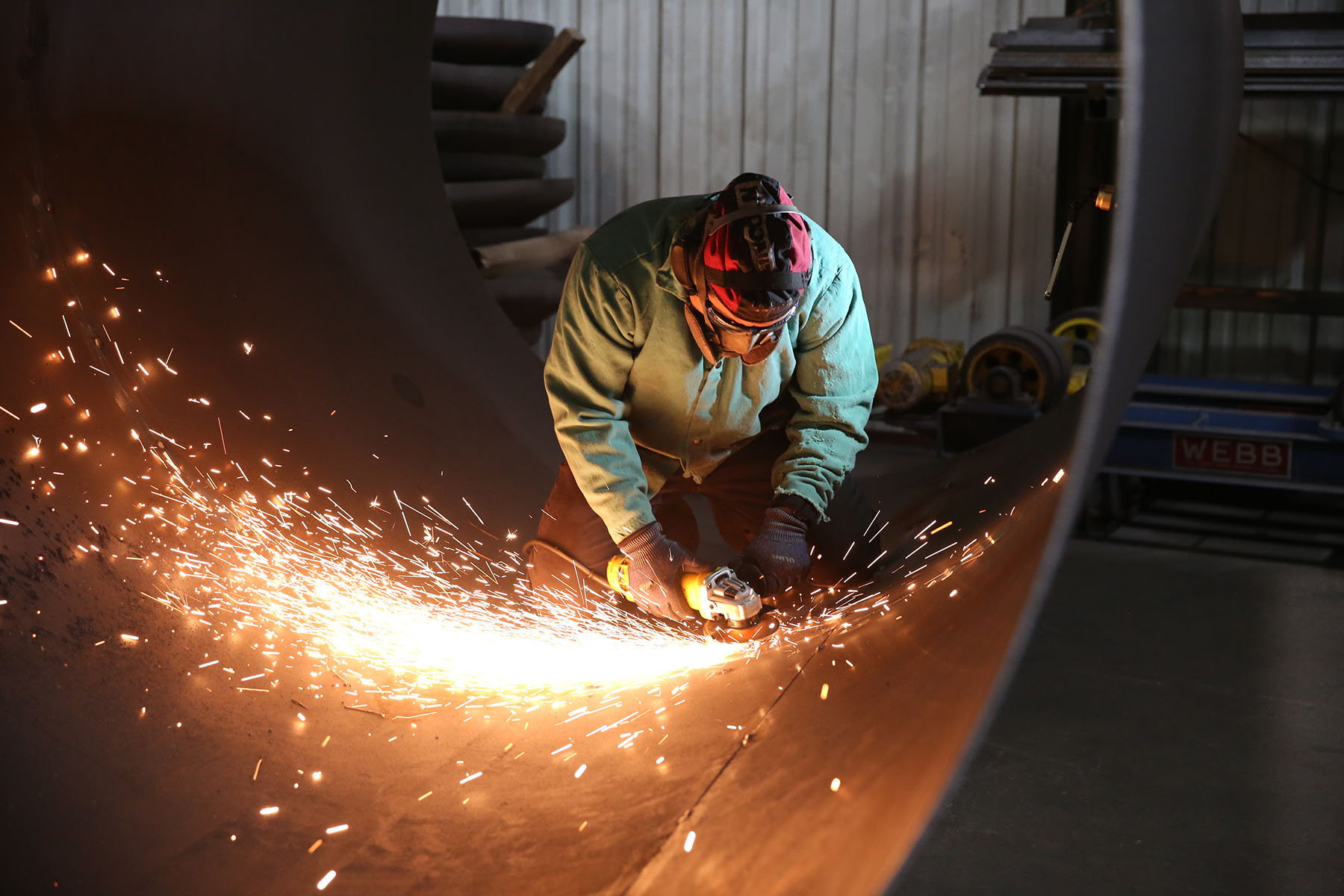
The Shop That Rolled It Is the Best Shop to Weld It
Finnco is not a standalone welding shop. The company doesn’t compete for general welding and fabrication work — there are plenty of shops that do that well. What Finnco provides is the welding that completes the rolling and forming work that is the core of the business.
When a cylinder comes off the plate rolls, someone has to close the seam. When a multi-hit formed part needs structural tack welds to hold its shape for transport, someone has to apply them precisely enough that the geometry doesn’t shift. When a pipe assembly needs circumferential welds after bending, someone has to understand how the bend affected the fit-up.
That “someone” should be the same team that formed the part in the first place. They understand the tolerances. They know where the material was stressed. They can see fit-up issues before the first arc is struck, and correct them at the source rather than grinding and shimming at a second shop.
This is the logic behind Finnco’s welding capability: single-source accountability from flat plate to finished component.
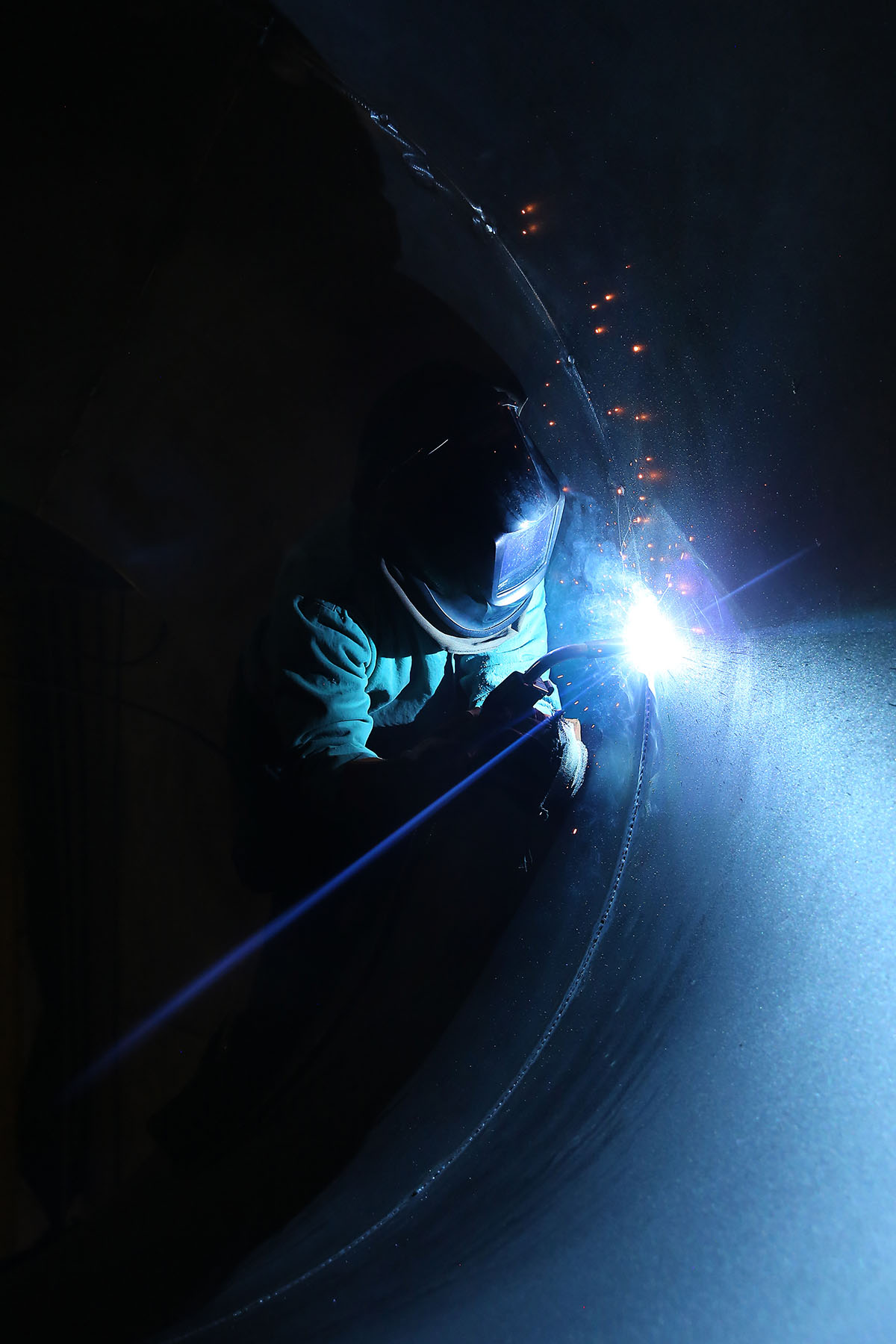
Welding Processes
SMAW (Shielded Metal Arc Welding / Stick Welding)
The most versatile process for heavy-formed parts. SMAW requires minimal setup, works in all positions, and handles the surface conditions common on recently rolled or formed plate minor scale, slight surface roughness, fit-up gaps that are typical in heavy forming work.
- Electrodes: E7018 (low-hydrogen) for A36 structural welds; E308L/E316L for stainless steel
- Applications: Tack welding rolled cylinders, structural connections on formed parts, field-style welds on heavy plate
- Strength: Versatility and penetration through less-than-perfect surface conditions
SAW (Submerged Arc Welding)
The specialist process for long, straight seam welds, and the reason Finnco can deliver rolled cylinders with production-quality longitudinal seams.
SAW works by completely submerging the weld arc under a bed of granular flux. The flux blanket eliminates arc flash, prevents atmospheric contamination, and produces deep-penetration welds with high deposition rates and a smooth, machine-finish bead that requires minimal grinding.
- Deposition rate: Significantly higher than SMAW or MIG, critical for thick-wall cylinder seams where multiple passes are required
- Weld quality: The flux protection produces welds with exceptionally low porosity and hydrogen content
- Applications: Longitudinal seams on rolled cylinders, long straight welds on formed plate assemblies
- Ideal match: SAW + plate rolling is the classic combination for tank shells, structural columns, and heavy ductwork
Weld Positioner
A dedicated pipe welding positioner that rotates the workpiece while the welder holds a fixed position. This allows all welding to be performed in the flat (1G) position, the easiest position for consistent, high-quality welds.
- Applications: Circumferential (girth) welds on pipe and tube, seam closure on smaller rolled cylinders
- Advantage: Continuous, unbroken bead with consistent penetration and appearance
Materials
- A36 Carbon Steel: Full SMAW and SAW capability. E7018 electrodes for structural-quality welds.
- Stainless Steel: SMAW with E308L/E316L electrodes. Requires careful heat management to maintain corrosion resistance at the weld zone.
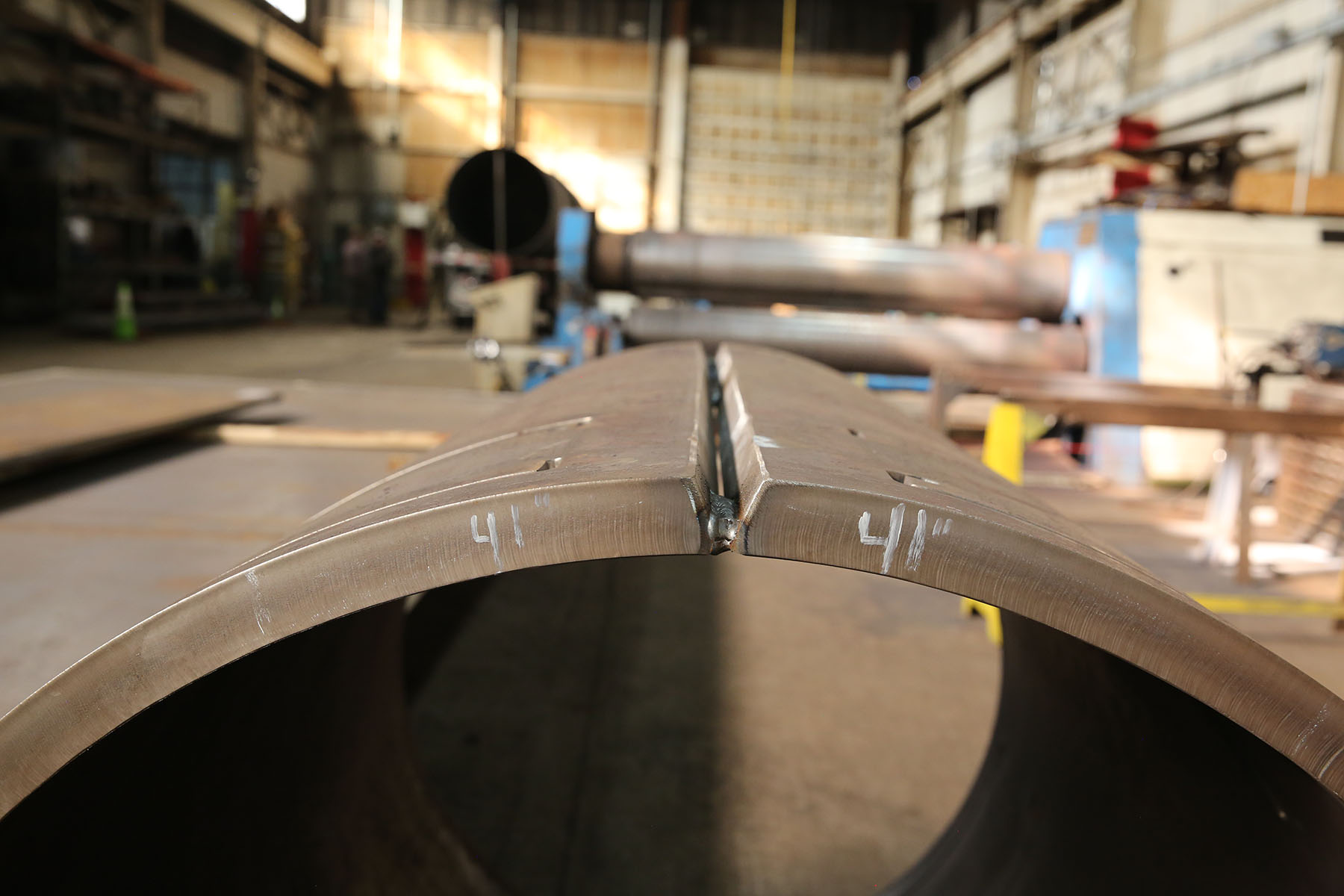
What Gets Welded at Finnco
Seam welding on rolled cylinders: The primary welding application. After a plate is rolled into a cylinder, the longitudinal seam is welded closed using SAW for production-quality results or SMAW for smaller or positional work. Full-penetration (CJP) welds are available for structural and pressure applications.
Tack welding for transport: Some customers prefer to do final welding in-house or at their own fabrication shop. Finnco tack-welds rolled or formed parts to hold the geometry stable during shipping. The customer completes the weld on their own floor.
Pipe and tube welding: Using the weld positioner for consistent circumferential welds on bent or rolled pipe assemblies. This completes the bending welding sequence for pipe work.
Weld preparation: Edges can be beveled before rolling or forming to provide proper joint geometry (V-groove, double-V, J-groove) so parts come off the rolls ready to weld without secondary edge preparation.
The Single-Source Advantage
The most common problem in outsourced welding is fit-up. A cylinder rolled at Shop A arrives at Weld Shop B with a seam gap that varies by 1/8″ over the length; maybe from the flat spots at the plate edges, maybe from spring-back, maybe from a tolerance that was “close enough” at the rolling stage. Now Shop B has to grind, clamp, force, and adapt. The weld takes longer. The quality risk increases. And if the part fails inspection, the finger-pointing begins.
At Finnco, the team that rolled the cylinder is ten feet away from the team that welds it. If the fit-up isn’t right, it goes back on the rolls. No shipping delay. No blame game. No cost surprise. The part gets welded right because it was rolled right, and both operations answer to the same standard.