
Fast Holes. Clean Edges. Ready to Form.
Punching is the fastest way to put a hole in steel plate, and in structural fabrication, speed means cost savings that compound across every piece in a production run. Where drilling a single hole takes minutes, punching takes seconds. Multiply that across 500 plates with 4 holes each, and the math makes itself obvious.
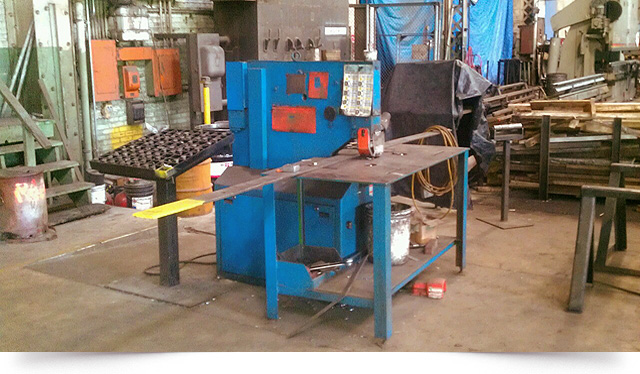
Finnco’s punching capability handles 1-inch diameter holes in A36 steel up to 0.5″ thick, the sweet spot for structural connections, bolt patterns, and mounting holes.
Punching A36 capacity: 1” diameter holes, up to .5” thick
Why Punch Instead of Drill
Speed. A punched hole is produced in a single stroke, less than a second. Drilling the same hole takes 30 seconds to several minutes depending on thickness. For production quantities, this difference is measured in hours of saved labor.
Consistency.
Every punched hole is identical; same diameter, same position, same edge condition. Drilling introduces operator variability on manual equipment.
Cost.
Less time per hole means lower cost per part. For structural work where a smooth bore isn’t required, punching is the most economical hole-making method available.
When drilling wins:
When tolerances are tighter than punching can hold (±0.001″ vs. punching’s ±0.005″-0.010″), when a smooth bore is required for bearing surfaces, or when the hole diameter is very small relative to material thickness.
Hole Anatomy
A punched hole isn’t perfectly cylindrical. Understanding its anatomy prevents spec surprises:
Rollover:
The slightly rounded top edge where the punch enters
Burnish:
The smooth, sheared portion of the hole wall (typically 30-40% of thickness)
Fracture:
The rougher, slightly tapered lower portion where the material broke
Burr:
The sharp edge on the exit side
For most structural and mechanical connections, this profile is fully acceptable. Where a smooth full-depth bore is required, drilling or reaming after punching is an option.
Workflow Integration
Punching is almost always a pre-forming operation. Holes punched after bending or rolling require expensive custom fixturing and risk dimensional error. The correct sequence:
- Shear to blank size
- Punch bolt holes, slots, and connection patterns
- Form on the press brake or roll on the plate rolls
At Finnco, all three operations happen in sequence on the same floor. The punch operator works from the same drawing that the brake operator will use; hole placement is referenced to bend lines, ensuring alignment after forming.
AISC Compliance
The American Institute of Steel Construction (AISC) permits punched holes in most structural applications, provided the material thickness doesn’t exceed the punch diameter plus 1/16″ for standard holes. For high-strength or fatigue-critical applications, AISC may require sub-punching and reaming. Finnco’s 1″ punch through 0.5″ A36 is well within standard AISC allowances for structural connections.
Edge distance requirements: AISC specifies minimum edge distances (typically 1.25× the bolt diameter) to prevent bulging or shear failure at the hole. Finnco follows these standards when punching connection patterns.
Common Steel Punching Applications
Bolt Patterns
Structural connections, base plates, flange connections
Slotted Holes
Thermal expansion allowance, field adjustment in structural steel
Connection Plates
Gusset plates, splice plates, clip angles
Drainage Holes
Equipment enclosures, hoppers, structural members
Mounting Holes
Brackets, guards, equipment supports