Every Shape. Every Orientation. Three Machines Deep.
Angle rolling is one of those services that looks simple on the surface but reveals its complexity the moment the job gets specific. “Roll a 3×3 angle to a 40-inch diameter” sounds straightforward, until the question becomes: leg in or leg out? And then: can you hold ±1/8″ on the arc without twisting the section?
That’s where capability separates from capacity. Finnco operates three section-bending machines, covering small structural shapes through heavy channels, wide flat bar, and I-beams, with the tooling and experience to handle orientation, distortion, and tolerances on every one.
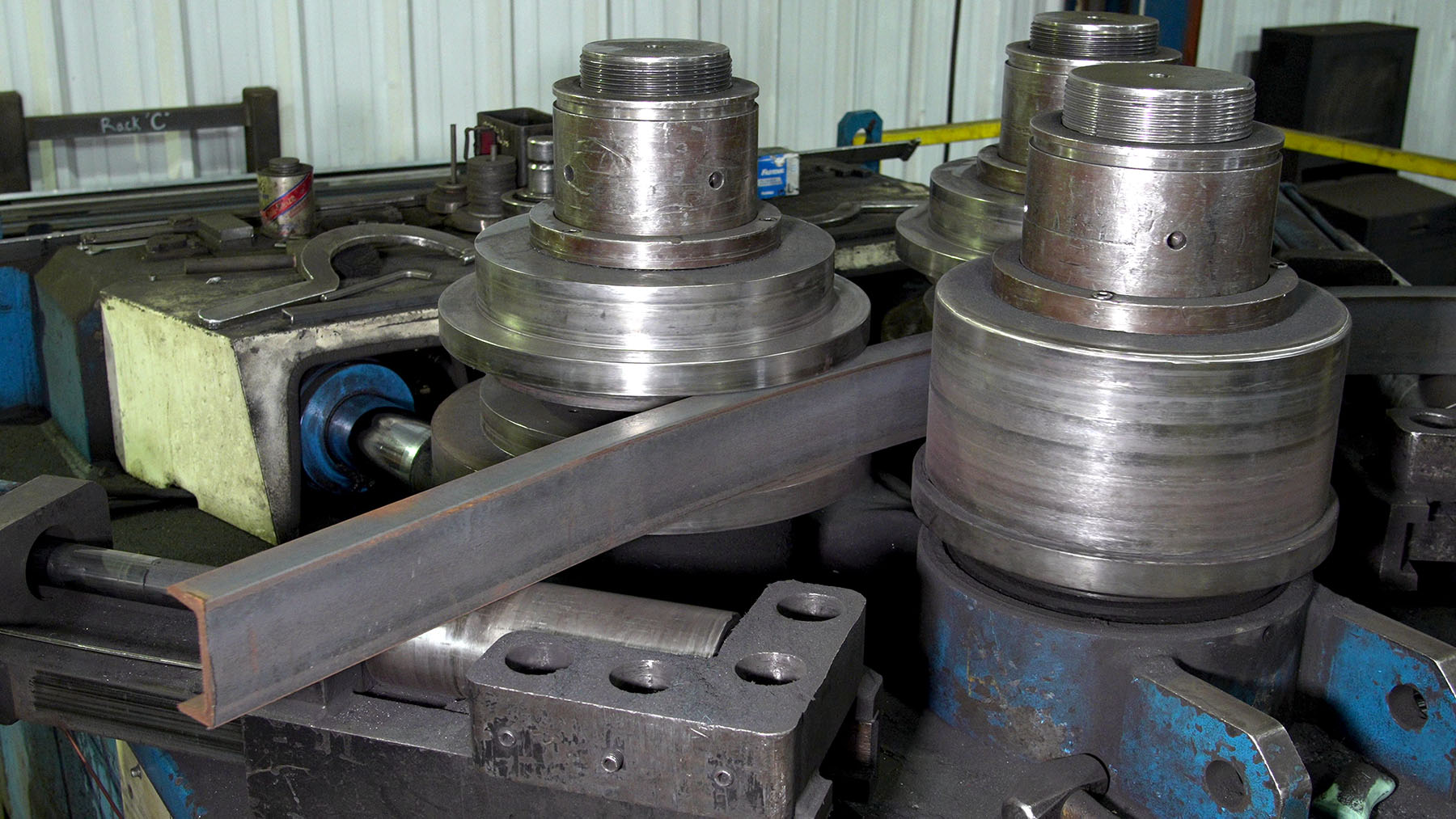
Rolling Equipment & Capacity
Machine 1 (Small to Medium Sections)
| Max angle capabilities | Max channel capabilities | Max FB capabilities |
|---|---|---|
| Leg IN: 2.5” x 2.5” x .3125” down to 40” Leg OUT: 3” x 3” x .3125” down to 30” | Leg IN: C5 x 9 to 28” Leg OUT: C5 x 9 to 32” | Hard way: 3” x .625” down to 20” EZ way: 8” x .75” down to 20” diameter |
| Max T-bar capabilities | Max SQ bar capabilities | Max Round bar capabilities |
|---|---|---|
| Leg IN: 3” x 3” x .3125” down to 30” Leg OUT: 3” x 3” x .3125” down to 35” Leg UP: 3” x 3” x .3125” down to 30” | 1.75” down to 18” diameter | Hard way: 3” x .625” down to 20” EZ way: 8” x .75” down to 20” |
| Max SQ tube capabilities | Max round tube capabilities | Max I-beam capabilities: |
|---|---|---|
| 2.5” x 2.5” x .1875” (with tube deformation) | 2.5” schedule 40 down to 32” (with tube deformation) 5 down to 28” diameter | 5 down to 28” diameter |
Machine 2 (Medium Sections)
| Max angle capabilities | Max channel capabilities | Max FB capabilities |
|---|---|---|
| Leg IN: 3” x 3” x .375” down to 40” Leg OUT: 3” x 3” x .375” down to 36” | Leg IN: 4.75” x 2” down to 28” Leg OUT: 4.75” x 2” down to 24” | Hard way: 3” x .5” to 25” EZ way: 5” x 1” to 28” |
| Max T-bar capabilities | Max SQ bar capabilities | Max Round bar capabilities |
|---|---|---|
| Leg IN: 3” x 3” x .375” down to 38” Leg OUT: 3” x 3” x .375” down to 30” Leg UP: 3” x 3” x .375” down to 32” | .75” down to 10” diameter | .75” down to 8” diameter |
| Max SQ tube capabilities | Max rec tube capabilities | Max round tube capabilities |
|---|---|---|
| 2.5” x .125” down to 32” diameter (with tube deformation) | 3.25” x 1” x .125” down to 32” diameter | 4” x .125” x down to 48” diameter (with tube deformation) |
Machine 3 (Heavy Sections)
| Max channel capabilities | Max angle capabilities | Max FB capabilities |
|---|---|---|
| Leg IN: 12” x 4” down to 48” Leg OUT: 12” x 4” down to 55” | Leg IN: 5” x 5” x .75” down to 60” Leg OUT: 5” x 5” x .5” down to 72” | Hard way: 5” x 1.5” down to 56” EZ way: 10” x 2.375” down to 56” |
| Max T-bar capabilities | Max SQ bar capabilities | Max Round bar capabilities |
|---|---|---|
| Leg IN: 6” x 6” x .625” down to 65” Leg OUT: 6” x 6” x .625” down to 60” Leg UP: 6” x 6” x .625” down to 40” | 4” down to 60” diameter | 4.375” down to 48” diameter |
| Max SQ tube capabilities | Max rec tube capabilities |
|---|---|
| 5” x .375” down to 100” diameter (with tube deformation) | 7” x 3” x .3125” down to 160” diameter (with tube deformation) |
What Finnco Rolls
Below is our range of typical material and profile types handled across all three of our roll forming and section bending machines:
- Angles: equal leg, unequal leg, all orientations
- Channels: C-shapes, MC shapes, leg in and leg out
- Flat Bar: hard way (on edge) and easy way (on flat)
- T-Bar: leg in, leg out, leg up
- Square Bar & Round Bar
- Square Tube & Rectangular Tube
- Round Tube & Pipe
- I-Beams
Rings, Arcs, and Spirals
- Full Rings: Rolled from structural sections into complete 360° circles. The section is over-rolled with extra “tangent” (straight material) at the ends, then trimmed and butt-welded to close the ring. Diameter tolerance of ±1/16″ to ±1/8″ depending on section size and material.
- Arcs & Segments: Partial curves, 90°, 180°, or any specified arc length. Common in architectural framing, tank stiffening rings, and structural supports.
- Spiral & Helical Rolling: Possible with the right setup. The section is progressively “led” out of plane during rolling to create a helix. Most common for spiral staircase stringers, handrails, and conveyor track.
Distortion Control
Finnco controls distortion through multi-pass rolling (gradual radius formation rather than forcing it in a single pass), lateral guide rolls that apply counter-pressure to resist twisting, and machine selection that matches the section’s load characteristics. For applications with tight deformation tolerances, architecturally exposed structural steel (AESS) matters enormously.
Every rolled section experiences some level of distortion. Tubes ovalize. Angles twist. Channel flanges tilt. The question isn’t whether distortion occurs, it’s whether the shop knows how to minimize it and whether the remaining distortion is within the customer’s tolerance.
Industries Served
Architecture & Construction
Curved canopies, arched entries, circular staircases, exposed structural curves (AESS).
Industrial & OEM
Conveyor tracks, equipment frames, guard structures
Critical Infrastructure
Curved bridge railings, tunnel supports, pipe supports and more.
Agricultural & Mining
Hopper supports, chute reinforcement, structural rings
Oil & Gas
Critical components such as tanks and pressure vessel stiffening rings, support rings, and flanges