
Bending and Welding Under One Roof
Tube and pipe bending is a natural extension of Finnco’s forming expertise. The same physics that govern plate rolling and press brake forming (material yield, spring-back, deformation control) apply when bending tube and pipe. The difference is the added challenge of maintaining cross-sectional integrity: a tube that flattens during bending isn’t a bent tube. It’s scrap.
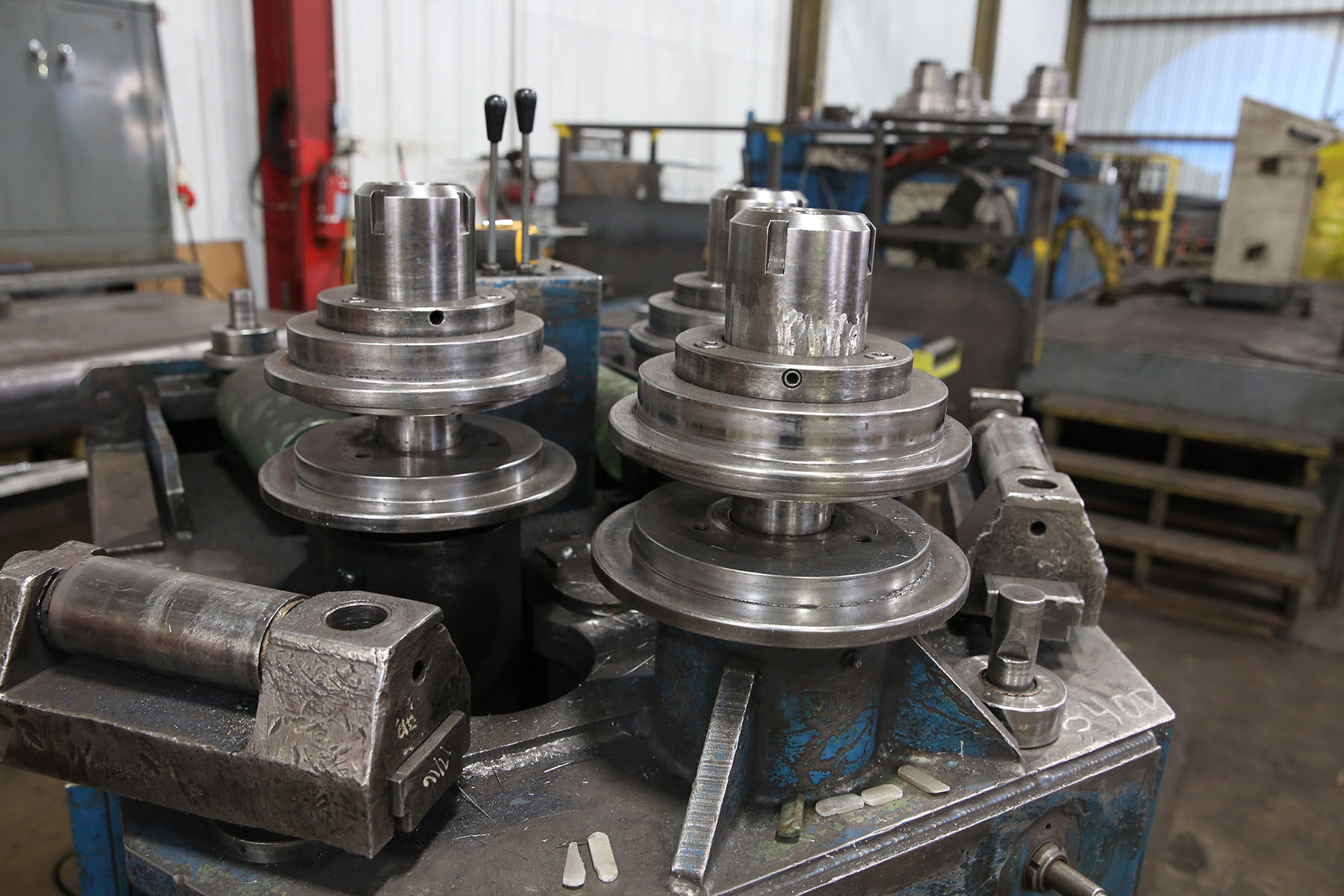
Finnco offers tube and pipe bending through two complementary methods: die-based bending on a dedicated profile bending machine and roll bending on the section rolling machines that also handle structural angles, channels, and bar.
Equipment & Capability
Profile Bending Machine
- Dies for 0.5″ Schedule 40 pipe
- Dies for 1″ Schedule 40 pipe
- Additional die sizes available – contact for specific requirement
Section Rolling Machines (Tube/Pipe Capability)
Finnco’s three angle rolling machines also handle round tube and pipe:
- Machine 1: Round tube up to 2.5″ Sch40, minimum 32″ diameter
- Machine 2: Round tube up to 4″ × 0.125″ wall, minimum 48″ diameter
- Machine 3: Larger structural tube and pipe on consultation
Weld Positioner
A dedicated pipe welding positioner for circumferential and seam welding on bent pipe assemblies. This means a bent pipe can be welded complete at Finnco — no second vendor required.
Tube vs. Pipe: A Critical Distinction
These terms are not interchangeable, and the specification method affects quoting, die selection, and feasibility:
Tube is specified by outside diameter (OD) and wall thickness in decimals. It’s used for structural and aesthetic applications where precision fit matters.
Pipe is specified by nominal pipe size (NPS) — an approximate inside diameter — and Schedule (wall thickness class). It’s designed primarily for fluid or gas transport and heavy structural support.
Finnco’s dedicated dies are sized for pipe (Schedule 40). Tube bending on the section rollers accommodates a wider range of ODs and wall thicknesses.
The Bending Process
Die-Based Bending: The pipe is clamped to a rotating bend die and drawn around it to a specified angle. This produces consistent, repeatable bends with controlled centerline radius. Best for tighter radii and production3*/0 consistency.
Roll Bending: Three rolls gradually curve the tube or pipe to a large-radius arc. Best for sweeping curves, rings, and structural arcs where the radius is large relative to the tube diameter.
Spring-Back: All tube and pipe springs back after bending. Carbon steel is predictable; stainless steel work-hardens and requires more aggressive compensation. Finnco’s operators calibrate for spring-back based on material grade, wall thickness, and radius.
Maintaining Cross-Section Integrity
The primary enemy of tube bending is ovality — the tube flattening at the bend. Several factors control this:
- Wall thickness relative to OD: Thin-wall tube (high wall factor) is more prone to flattening
- Bend radius: Tighter radii create more deformation
- Die fit: Properly matched dies support the tube through the bend
- Material: Stainless work-hardens; aluminum can crack at tight radii depending on temper
For applications where ovality tolerance is tight, Finnco selects the die and method that minimize cross-sectional distortion for that specific tube specification.
The Bending + Welding Advantage
Many bent tube or pipe assemblies require welding, whether it’s closing a seam, joining bent sections, or connecting fittings. Finnco’s welding capability (SMAW and SAW on A36 and stainless) plus the dedicated weld positioner means bent pipe can be completed in the same facility where it was formed.
This eliminates the most common problem in multi-vendor pipe fabrication: a bent pipe that arrives at the weld shop slightly out of spec, requiring rework or shimming before the weld can be made. When the same team bends and welds the part, fit-up issues are caught and corrected in real time.
Applications
Handrails & Guardrails
Architectural and industrial railing systems
Structural Frames
Equipment frames, roll cages, canopy structures
Piping Systems
HVAC, industrial exhaust, process piping
Furniture & Fixtures
Commercial and industrial furniture components
Equipment Components
OEM frames, mounting structures, support arcs
