
Metal Forming Services That OEM’s Rely On
“Can you form this?”
That’s the question Finnco hears most, and it usually comes from a buyer who has already been told “no” somewhere else. “The material is too thick”, “the radius is too tight”, “the geometry requires four hits in a specific sequence on a press brake with enough tonnage and enough bed to get it done.” we’ve heard it all!
Finnco has two heavy press brakes built for exactly this work.
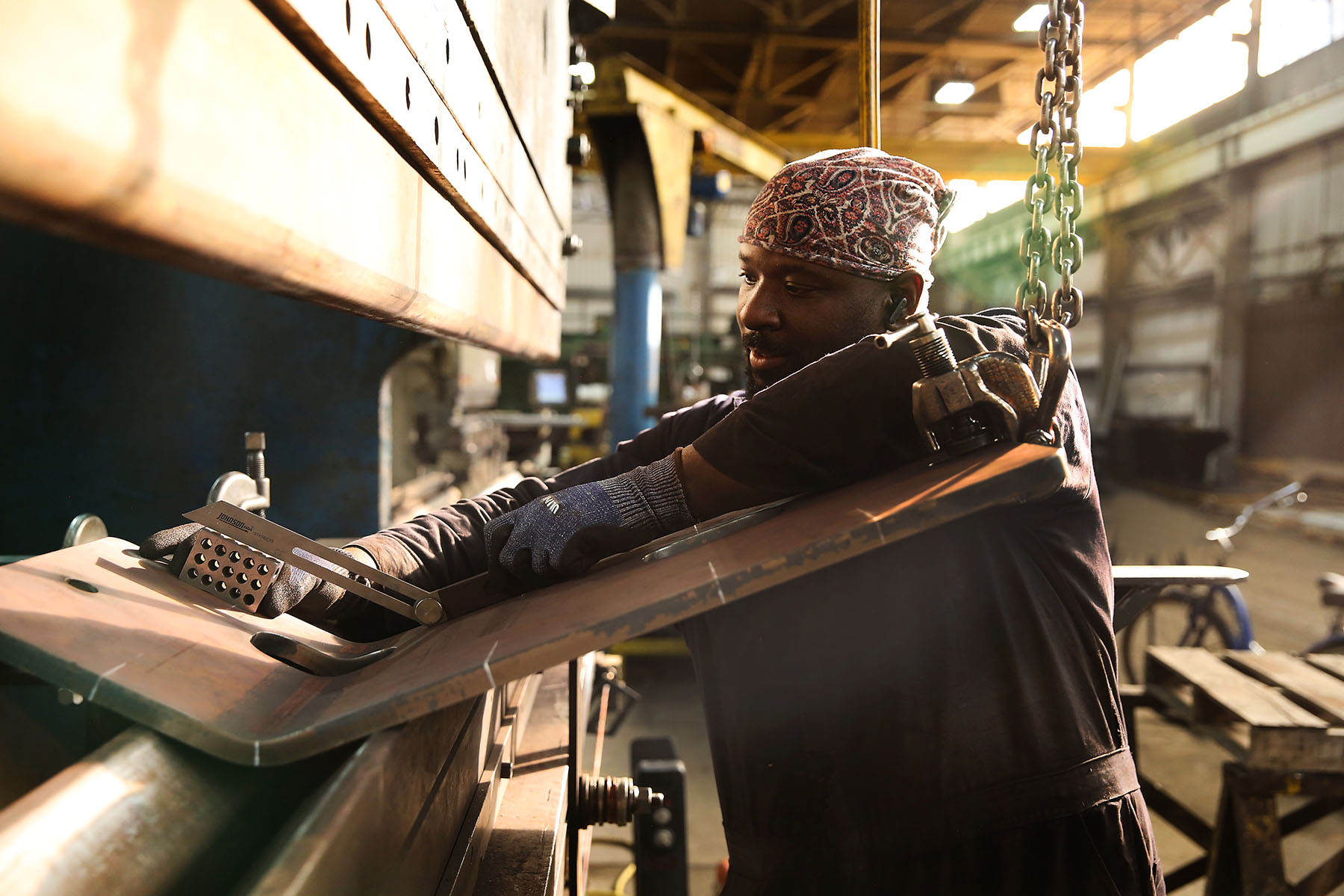
Our Metal Forming Equipment & Capacity
| 750 Ton 16’ Long Bed | 400 Ton 12’ Long Bed |
|---|---|
| This is the machine that handles what most shops can’t touch. Seven hundred fifty tons of forming force across a 16-foot bed, with an assortment of dies matched to the range of materials and geometries that move through the shop. | The second brake covers lighter and mid-range work, keeping the 750-ton machine available for the heavy jobs it alone can handle. |
| A36 Examples | A36 Examples |
| 16’ long up to .75” thick 8’ long up to 1” thick | 12’ long up to .375” thick 8’ long up to .5” thick |
| GR50/SS Examples | GR50/SS Examples |
| 16’ long up to .625” thick 5’ long up to 1” thick | 12’ long up to .25” thick 10’ long up to .3125” thick 7’ long up to .5” thick |
| T-1/AR Examples | T-1/AR Examples |
| 16’ long up to .5” thick 4’ long up to .75″ thick | 12’ long up to .1875” thick 8’ long up to .3125″ thick |
Both presses carry an assortment of V-dies, gooseneck punches, and radius tooling, which allows us to handle everything from tight 90-degree bends to sweeping multi-hit curves.
What Makes a Part “Hard to Form”
Finnco’s reputation isn’t built on easy work. It’s built on the jobs that sit in other shops’ “too difficult” pile:
Thick Plate at Tight Radii
Bending 1-inch A36 into a tight channel requires serious tonnage concentrated over a short length. The 750-ton brake provides roughly 47 tons per foot; enough force to form parts that would stall a 200-ton machine.
High-Strength Materials
AR400 plate has a spring-back of 10 to 15 degrees, five to seven times more than A36. Every hit must be over-bent by a calculated amount, and the angle must be verified before moving to the next bend. There’s no “undo” in press brake work on AR plate. One mistake means a scrapped part, and at $8 to $12 per pound for AR400, that’s an expensive mistake.
Multi-hit complexity
Some parts require 10, 15, or 20 sequential bends to achieve a large-radius curve or a complex profile. Each hit compounds any error from the previous one. A single half-degree deviation multiplied across 20 hits produces a part that’s 10 degrees off spec. This demands precise back-gauge positioning and operators who understand cumulative tolerances.
Parts that need forming AND rolling
A conical hopper transition might start as a flat plate, get pre-formed on the brake, then move to the plate rolls for the final curvature, and finally to the welding station for seam completion. This multi-operation sequence is Finnco’s signature, all under one roof, one quality standard, one timeline.
Materials Under The Break
A36
Predictable. Moderate spring-back of 1-2 degrees. The standard material for structural forming and the most forgiving under the brake.
Grade 50 (A572)
Higher yield means more spring-back and higher tonnage demand. At the same thickness, Grade 50 requires approximately 30% more force than A36.
AR400 / AR500:
The most demanding press brake work. High hardness means the bending radius must be generous (minimum 3× to 5× material thickness) or the outside of the bend will crack. Grain direction matters; bending across the grain dramatically reduces cracking risk.
T-1 (A514)
Quenched and tempered high-strength steel. Requires careful radius selection and experienced operation. Too tight and it fractures; too loose and it doesn’t hold the angle.
Stainless Steel
Work-hardens with each hit. The operator can’t hesitate or re-strike, every pass must count, or the material becomes progressively harder and more prone to cracking.
The Multi-Operation Advantage
Many formed parts don’t stop at the brake. They move through a multi-sequence fabrication process:
Sheared to blank size on the 16′ hydraulic shear
Punched for bolt holes or connection patterns
Formed on the brake, single bend or multi-hit
Rolled on the plate rolls if the part requires curvature beyond what the brake can achieve
Welded; seam, tack, or structural, depending on the application
This entire sequence happens at Finnco. No truck rides between vendors. No tolerance drift from one shop’s setup to another’s. One set of hands, one quality standard, one point of accountability.
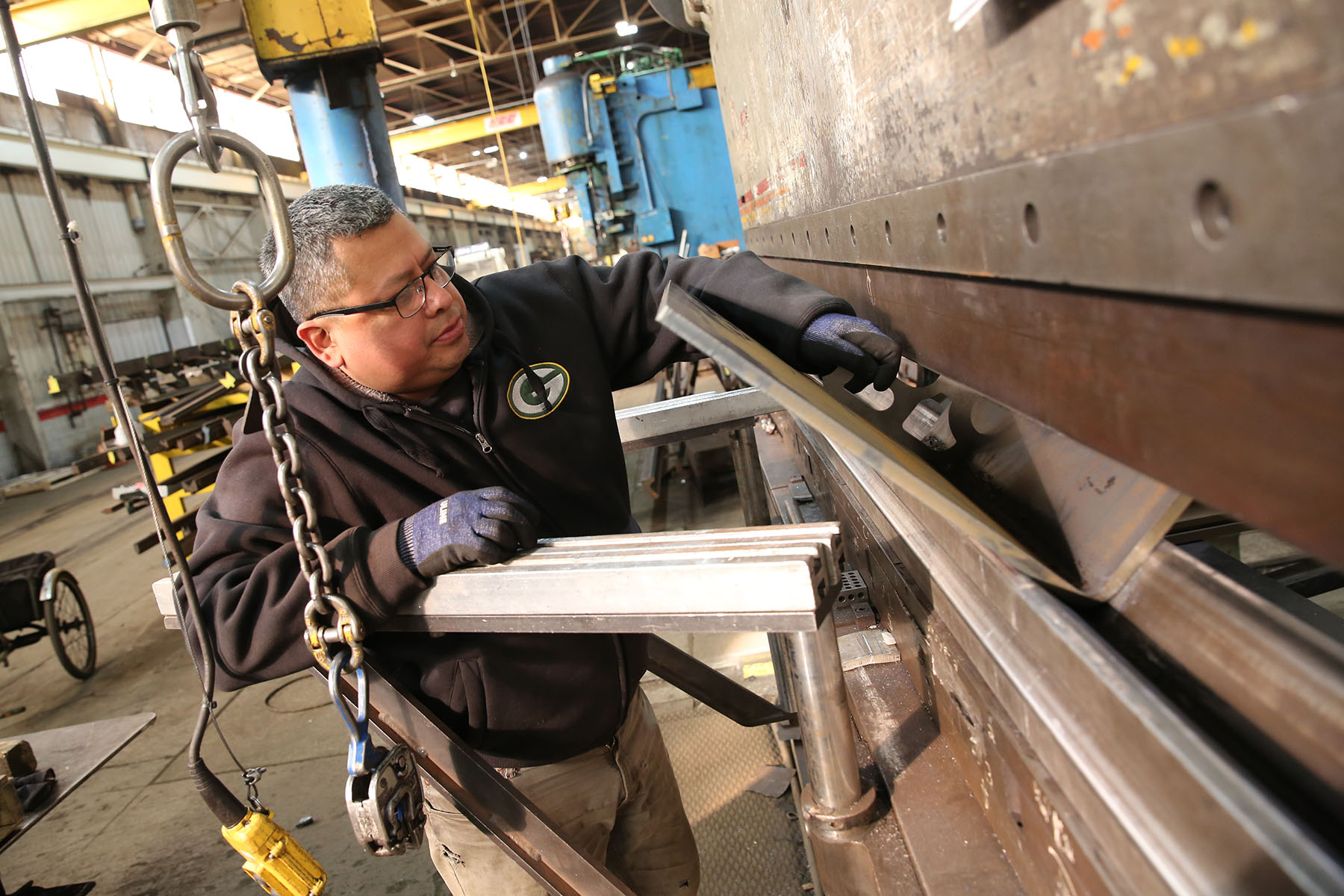
Industries Served
Mining
Shovel buckets, truck body liners (AR400), chute components
Military & Defense
Armored vehicle plating, structural channels
Construction
Crane booms, structural C-channels, heavy brackets
Agricultural Equipment
Hopper transitions, frame components, wear parts
Heavy Machinery
Mounting brackets, guard panels, structural supports